On October 1st, I was doing something completely ordinary—cleaning out old emails and attachments that had been taking up space for years.
And then I found a letter.
Not just any letter.
It was the first time I had written “Giovanni’s Story,” only about two months after losing my son.
And of all the days I could have found it, I found it on October 1st.
Thirteen years ago, on October 1, 2013, Giovanni mistakenly ate a snack that contained peanuts and suffered the anaphylactic reaction that would ultimately take his life. He fought for almost three weeks before passing away on October 18.
I sat there reading words I had written when everything was still so fresh, and memories came flooding back—some I hadn’t thought about in years and others I had honestly forgotten.
I guess the brain has a funny way of allowing us to forget some of the details of traumatic events. Maybe that’s part of how we learn to keep moving forward.
Before I Knew What I Didn’t Know
Food allergies had been part of Giovanni’s life almost from the beginning.
As a baby, he had trouble with different formulas—reflux, loose stools, rashes and eventually eczema that became incredibly difficult to control. He developed asthma very young.
As we began introducing foods, there were little things I noticed. Red cheeks. Reflux. Crankiness.
I didn’t know those things could be connected to food allergies.
Then, at around 18 months old, Giovanni took one bite of chicken with peanut sauce. He developed hives, his eyes swelled and his nose started running.
I called our pediatrician. I was told to give him an antihistamine and bring him in.
Eventually we saw an allergist and learned Giovanni was allergic to peanuts and eggs, along with several environmental allergens. I was given prescriptions for antihistamines and EpiPens and shown how to use an EpiPen in an emergency.
But what was an emergency?
Anaphylaxis was never explained to me. In fact, I don’t recall ever even hearing the word “anaphylaxis” back then.
I don’t remember anyone sitting me down and explaining what anaphylaxis could look like, what symptoms I should be watching for, or when epinephrine should be given. I don’t remember leaving with an emergency action plan. I had an EpiPen and knew how to use it, but I didn’t truly understand when I was supposed to use it.
Giovanni had a few accidental exposures to peanuts over the years. At the time, we considered those reactions “mild.” That’s how they appeared to us, and that’s how they were treated.
He would usually vomit, sometimes develop hives, or complain of a scratchy or tingly throat. We would give him Benadryl, his symptoms seemed to calm down and go away, and we believed the reaction was over.
Today, I know those reactions weren’t “mild” at all. Those were symptoms that are part of anaphylaxis. We just didn’t know it.
When I followed up with his pediatrician, all I can remember is being told to give him antihistamine and that because his reactions had been “mild,” he should be okay. I also remember being told that if we didn’t have to give the EpiPen, we were better off because of concerns about what it could do to his heart.
So that became my understanding.
Benadryl first. Watch him. The EpiPen was for when things became really serious.
I didn’t understand that anaphylaxis could already be happening before a reaction looked frightening. I didn’t understand that antihistamines do not stop anaphylaxis. I didn’t understand that one reaction does not predict what the next reaction will look like.
And I didn’t understand that epinephrine wasn’t supposed to be the last resort.
It was supposed to be the first-line treatment for anaphylaxis.
I wish more than anything that I had understood that then.
October 1, 2013
Giovanni had just started his freshman year at Holy Trinity High School.
That night we were excited because homework, dinner and chores were finished early. Between school, studying and sports, we hadn’t had much time to just relax together.
We decided to have a movie night.
Just Giovanni and me.
We grabbed some snacks, including a snack mix containing mini cookies, pretzels, almonds and M&M’s.
I thought I knew how to read an allergy label.
Like many parents at the time, I went straight to the allergen warning. I saw “may contain tree nuts.”
Giovanni wasn’t allergic to tree nuts.
I thought we were okay.
He ate only a few pieces before saying:
“Oh no, there’s peanuts in here!”
I told him he had to be mistaken.
I looked again.
This time I read further.
Peanuts were actually an ingredient, but listed almost at the end of ingredient list.
I immediately gave him antihistamine and decided we should go to an after-hours clinic just to be safe. At first, he was talking. His throat was a little scratchy. He was even giving me a hard time about getting dressed to go.
And then came a moment that I will carry with me forever.
The EpiPen was sitting on the table next to my purse.
Giovanni asked me:
“Should I Epi?”
I said I didn’t think we needed it.
We had never needed it before.
Let’s just get to the doctor.
Those words are difficult to write even thirteen years later.
The clinic was only about seven minutes away. Giovanni was still talking during the drive. He had his inhaler and used it a few times. I kept reassuring him that he was going to be okay.
When we arrived, the clinic had just closed.
No one answered the door.
We got back into the car and started looking for the EpiPen, but we couldn’t find it.
So I headed toward the emergency room, another several minutes away.
I remember focusing on getting there as quickly as I could without crashing. My hazard lights were on. I was beeping the horn, safely going through red lights when I could and constantly reassuring Giovanni.
We’re almost there.
You’re going to be okay.
Just hold on.
We were around the corner from the hospital when Giovanni said:
“I can’t mom. I don’t want to die.”
I told him no.
No.
That wasn’t going to happen.
We were there.
Just hold on another minute.
And then he stopped answering me.
As I turned toward the emergency room, I grabbed his hand.
It was cold.
I looked at him.
My beautiful boy was blue.
I pulled into the emergency room entrance screaming and beeping the horn for someone to help us.
People came running. Hospital staff rushed outside. I remember everyone trying to get Giovanni out of the car and into the emergency room while I screamed that he had a peanut allergy and begged them to help him.
Then they took him away from me.
And I waited.
Nearly an hour later, a doctor came in.
Giovanni’s heart had stopped. They had worked on him for quite some time and were able to bring him back, but he had been without oxygen for approximately three minutes.
He was unconscious and on a respirator.
He was transferred to a pediatric ICU and placed into a medically induced coma in hopes of allowing his brain to recover from the lack of oxygen.
For almost three weeks we hoped.
We prayed.
We waited for our miracle.
But the injury to his brain was too severe.
On October 18, surrounded by the people who loved him most, I climbed into that hospital bed and held my little boy along with his dad and his sister. Our closest family surrounded us, holding hands and holding one another up as Giovanni left this world.
He was 14 years old.
Anaphylaxis Is How Giovanni Died. It Is Not Who He Was.
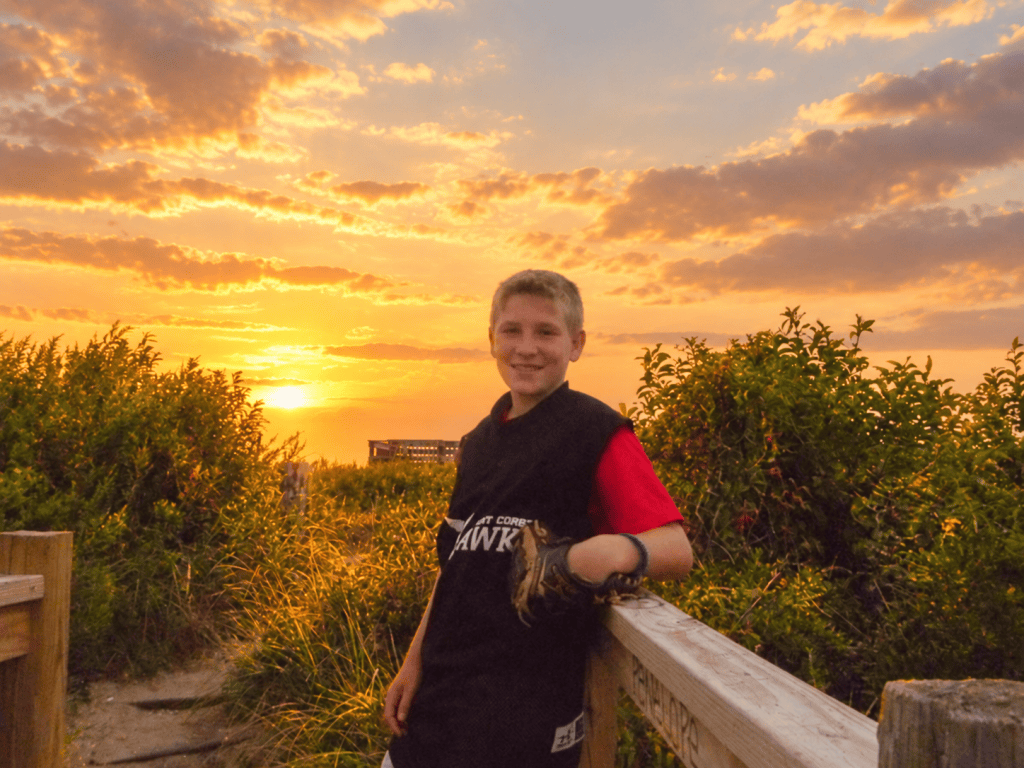
Giovanni was a happy kid.
There was almost always a smile on his face.
He seemed to wake up running and didn’t stop until he went to sleep—and sometimes he didn’t stop moving even then.
For a while, he was Spiderman, literally climbing the walls as far as he could whenever he could.
Then he was the Green Power Ranger, always in Ranger mode.
He started playing sports when he was five—baseball and soccer, and later football. As he got older, he moved away from football and soccer and found his true love in baseball.
He was a talented athlete.
He was an honor student.
He was a best friend.
He was the best brother.
He was his dad’s pride and joy.
And he was my little boy, my little man, my friend and my partner. He took care of me and I took care of him. He was the reason I did everything I did.
Giovanni made friends everywhere he went.
He had only been at Holy Trinity for about a month when this happened, yet the number of students who came to see him and later came to us with stories about how he had already touched their lives was overwhelming.
That is Giovanni.
And that is the boy I want people to know.
Reading My Own Grief Thirteen Years Later
Reading that old letter was hard.
I could hear the grief in every sentence.
And I could hear the guilt I will always carry with me.
I should have called 911.
I should have given the EpiPen.
I should have known.
There were also things I wrote because they reflected what I understood at the time that I now know were wrong.
I wrote that EpiPens should be kept in cars. Today we know epinephrine needs to be protected from temperature extremes and should be carried with you.
I even wrote that I should have made Giovanni vomit after he ate the peanuts.
We know today that you should not induce vomiting after an allergen exposure.
But I don’t want to erase those words.
Because they tell another important part of the story.
They show the mother I was then.
I had already learned so much in the two months after Giovanni died, but there was still so much I didn’t know.
And thirteen years later, I can see just how far that journey has taken me. I’m still learning!
What Does Healing After Losing a Child Even Mean?
I don’t believe you “get over” losing your child.
Thirteen years later, I certainly haven’t.
Grief changes shape.
There are times when it is loud and consuming. Other times it settles quietly somewhere inside you while life continues around it.
And then you can be doing something as ordinary as cleaning out your email and suddenly you’re right back there.
For anyone grieving a child—or someone they deeply love—I wish I could give you instructions for healing.
I can’t.
I don’t think they exist.
Give yourself permission to grieve in whatever way you need to grieve.
Say their name.
Talk about them.
Cry when you need to cry.
And laugh when a memory makes you laugh without feeling guilty for it.
Ask for help when you need it.
And when you’re ready, maybe find somewhere for all of that love to go.
For me, eventually, that became advocacy.
That doesn’t have to be someone else’s path.
It might be volunteering. Art. Faith. Helping another family. Creating something in your child’s memory. Supporting something they loved.
Or maybe, for a while, being brave simply means getting out of bed and continuing to live.
There is courage in that too.
When Grief Became Purpose
Only two months after Giovanni died, I wrote this in that original letter:
“We want to help educate and advocate for all families with food allergies.”
Reading that sentence thirteen years later stopped me.
Because the woman who wrote those words had absolutely no idea where they would lead.
She didn’t know there would one day be a Love for Giovanni Foundation.
She didn’t know she would educate families about anaphylaxis or train people to administer epinephrine.
She didn’t know there would be EPI FIRST, EPI EVERYWHERE™.
She certainly didn’t know that Giovanni’s story would eventually inspire Gio’s Law and a mission to put epinephrine into the hands of first responders, throughout our communities, and certainly never fathomed nationally…
She was simply a mother who had lost her child and desperately wanted to prevent another family from experiencing the same thing.
Somewhere along the way, my question changed.
Instead of only asking:
How could this have happened to Giovanni?
I began asking:
What can I do to keep it from happening to someone else?
I couldn’t change what happened on October 1, 2013.
I couldn’t go back to that kitchen table and answer Giovanni’s question differently.
I couldn’t put the epinephrine in his leg.
I couldn’t change those minutes.
Believe me, there have been countless times I wished I could.
But I could learn.
I could teach.
I could speak.
I could advocate.
And I could make sure another parent understands something I didn’t understand clearly enough that night:
Don’t wait for anaphylaxis to look the way you think it should look. Hives and breathing problems may not always be part of the reaction. Don’t wait and see if symptoms get worse. When epinephrine is indicated, give it.
Epinephrine can only save a life if we give it.
Brave Enough to Keep Going
I used to think being brave meant not being afraid.
I don’t anymore.
Sometimes bravery is being terrified and moving forward anyway.
Giovanni had to learn how to live in a world with food allergies.
After losing him, I had to learn how to live in a world without him.
And eventually, I had to become brave enough to take the most painful part of my life and talk about it over and over again in the hope that someone else’s story might end differently.
Advocacy didn’t heal my grief.
It gave my grief somewhere to go.
And maybe even more importantly, it gave all of the love I still had—and will always have—for Giovanni somewhere to go.
Thirteen years later, I still miss him.
I still wish more than anything that the Love for Giovanni Foundation never needed to exist.
I would trade every accomplishment, every law, every training, every person reached and every bit of recognition to have my son sitting beside me again.
But that isn’t a choice I get to make.
The choice I do get to make is what I do with the life I still have.
So I will continue saying his name.
I will continue telling his story.
I will continue teaching families what I wish someone had taught me.
I will continue fighting to put epinephrine wherever it may be needed.
And I will continue trying to turn unimaginable loss into something that might save another life.
Finding that letter today reminded me that healing isn’t forgetting.
Maybe sometimes our minds allow us to forget pieces of the trauma because that’s what we need in order to survive it.
And sometimes, years later, a memory finds its way back.
Thirteen years ago, I was brave enough to keep going.
Eventually, I became brave enough to turn grief into advocacy.
And today I understand that carrying Giovanni forward doesn’t mean holding onto every painful moment.
It means carrying his love with me into everything that comes next.
For Giovanni. Always.
EPI FIRST, EPI EVERYWHERE™ — A LOVE FOR GIOVANNI FOUNDATION | GIO’S LAW INITIATIVE


Leave a comment